
Higher Corruption Risk Functions in the Activities of Committee for Sanitary and Epidemiological Well-Being and Public Health Identified
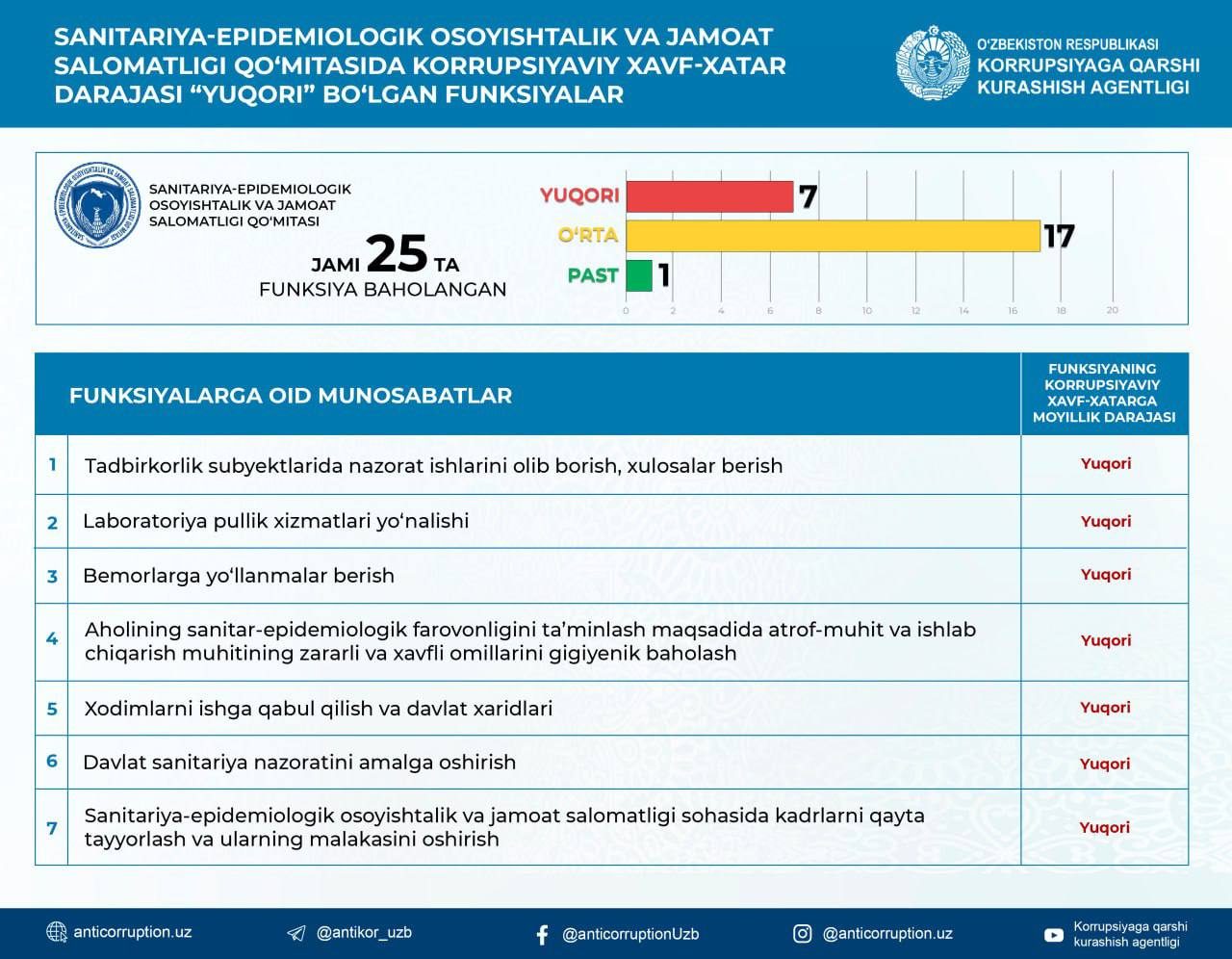
In accordance with the Resolution of the President No. 240 of May 11, 2022, a corruption risk assessment in the activities of the Committee for Sanitary and Epidemiological Well-Being and Public Health has been carried out through e-anticor.uz electronic platform.
The assessment of 25 functions revealed that the risk level for 7 functions determined to be ‘high’, 17 functions – ‘medium’ and one function – ‘low’.
The functions with high level of corruption risks include:
- conducting inspections of business entities, issuing conclusions;
- providing paid laboratory services;
- issuing referrals to patients;
- hiring employees and conducting public procurement;
- retraining and advanced training of personnel.
Currently, the Committee is working to eliminate existing risks based on the anti-corruption program.
It is worth to note that an organization with a large number of functions with a high corruption risk is not considered ‘the most corrupt’, persons holding positions with a high corruption risk are not considered ‘corrupt’, or, conversely, organizations with a predominantly ‘low’ corruption risk are not considered ‘free from corruption’.
These situations are an indication that these organizations have sufficient control measures in place or that additional control measures need to be taken, while the heads of organizations must take separate control of processes (functions) and positions with a high corruption risk.
Press Office
The Anti-Corruption Agency